
SMOKE SIGNALS - EPISODE 3 WHEN THE FUSE IS SOFTWARE, AND VEHICLES COMMUNICATE
The Modern Vehicle Is Communicating. Are We Preserving the Conversation?
What if one of the most important pieces of evidence in a vehicle fire could be changed after the fire?
No component would need to be removed.
No wire would need to be cut.
No one would even need to touch the vehicle.
The change could occur remotely through a software update, an owner application, a manufacturer connection, or another communication between the vehicle and the systems managing it.
That question is no longer theoretical.
Modern vehicles do more than transport people. They monitor conditions, generate alerts, record system activity, communicate with owners and manufacturers, and receive commands and software updates in return.
The modern vehicle is not simply a machine. It is part of a connected, two-way information system.
When that vehicle becomes involved in a fire, the conversation between the vehicle, the owner, and the manufacturer may become part of the fire scene.
THE PUBLIC CASE
In August 2026, Lucid USA filed a safety recall involving 27,185 model year 2022 through 2026 Lucid Air electric vehicles.
According to the National Highway Traffic Safety Administration filing, software controlling certain low-voltage exterior lighting circuits could provide insufficient overcurrent protection. The software could allow a circuit to remain energized at an excessive amperage level, potentially resulting in overheating, smoke, or fire.
The affected protection system uses an electronic fuse, commonly referred to as an eFuse. Unlike a conventional fuse that physically opens when excessive current passes through it, an eFuse uses electronic controls and programmed logic to monitor and interrupt current.
The reported concern was therefore not limited to whether a conductor, connector, or lighting component could physically fail. It also involved the software logic responsible for determining when the affected circuit should be deenergized.
Lucid's investigation reportedly identified three fire events involving front lighting areas over approximately three years, four smoke incidents involving the center high-mounted stop-lamp circuit, and 33 additional warranty reports involving potentially related wiring-harness damage.
The first identified event involved a 2023 Lucid Air that sustained a fire in the left-front portion of the vehicle. According to the recall chronology, a definitive root cause was not established, although the front combination lamp could not be eliminated as a potential source.
That distinction matters.
The first event did not independently establish a conclusive cause. It became one part of a broader investigation that also considered subsequent fire events, smoke reports, warranty information, electronic data, design schematics, and the system's overcurrent-protection strategy.
The resulting remedy was not limited to replacing a physical fuse or electrical component.
It was a software update.
Software version 2.10.0 lowered the applicable eFuse amperage thresholds and disabled logic that could allow a faulted circuit to become reenergized during the same key cycle. The update was delivered remotely through an over-the-air system.
At the time of the recall filing, 20,719 vehicles had reportedly received the updated software. Another 6,466 had not. Owners of vehicles that had not received the update were advised to park outside and away from structures until the remedy was completed.
This presents an important forensic question:
What version of the vehicle is the investigator examining?
Is it the version that existed when the fire occurred, or the version that exists when the examination takes place?
Those may not be the same vehicle from an operational standpoint, even when the physical vehicle never moved.
THIS IS NOT ONLY AN ELECTRIC-VEHICLE ISSUE
It would be easy to view this case as another discussion about electric-vehicle propulsion batteries.
That would miss the larger lesson.
The recalled condition involved low-voltage exterior lighting circuits and the software controlling their overcurrent protection. It was not limited to the high-voltage battery.
More importantly, connected-vehicle technology is not exclusive to electric vehicles.
Modern gasoline, diesel, hybrid, and electric vehicles, including commercial vehicles, heavy equipment, and agricultural machinery, may contain interconnected modules, networked controls, telematics, remote services, owner applications, software-driven protection strategies, and manufacturer communication platforms.
Depending on the vehicle, equipment, subscription services, and owner settings, available information may include:
Diagnostic trouble codes and electronic faults
Battery voltage, state of charge, and charging activity
Thermal-management and electrical-system conditions
Warning indicators, alarm activations, and emergency events
Vehicle location and operational history
Software and firmware versions
Completed, pending, interrupted, or failed updates
Service, repair, recall, and warranty information
Remote commands sent to or received by the vehicle
Owner-application alerts and connected-service communications
Not every vehicle collects the same information. Not every manufacturer retains it for the same period, and not every record will be accessible to every interested party.
That uncertainty makes early identification and preservation more important, not less.
THE TWO-WAY CONVERSATION
Connected vehicles do not only send information outward. They may also receive information and commands.
A vehicle may communicate a fault, warning, or operating condition to a manufacturer-controlled platform. The manufacturer or service provider may then communicate back through an owner application, dashboard notification, email, text message, customer-service contact, recall notice, or remote software update.
The owner may also communicate back to the vehicle. Depending on the system, an owner application may allow the user to check charging status, start or stop charging, lock or unlock the vehicle, activate climate controls, locate the vehicle, review vehicle-health information, view warnings, authorize updates, or contact roadside assistance.
Those communications may create several records from the same event.
An electrical condition could generate a fault within the vehicle, transmit information to a manufacturer server, create an alert in the owner's application, produce a notification on a mobile phone, and result in a customer-service or roadside-assistance contact.
One record may establish what the vehicle detected. Another may establish when the information was transmitted. Another may show what the owner was told. Another may document whether an update was pending, downloaded, interrupted, or completed. Manufacturer records may also show whether information or a remote command was sent back to the vehicle.
No single communication automatically establishes the cause of a fire. Together, however, these records may help establish the vehicle's configuration, warnings, activity, and communications immediately before or after the incident.
That can be highly consequential evidence.
THE RECALL IS NOT THE CAUSE
A recall involving a fire hazard is relevant to a fire investigation.
It is not a cause determination for every fire involving that product.
The existence of a recall does not establish that a particular vehicle fire originated within the recalled system. It does not establish that the reported defect was present, active, or causally connected to the specific loss.
A recall identifies a condition requiring evaluation. The investigation must still determine whether that condition can be connected to the evidence from the specific fire.
That requires more than locating a vehicle identification number on a recall list.
The investigation must still ask:
Where did the fire originate?
Were the affected circuits or components located within the identified area of origin?
What software and firmware versions were installed when the fire occurred?
Did an update occur before or after the incident?
Were electrical, thermal, charging, lighting, or vehicle-health warnings generated?
Were alerts transmitted to an owner application or manufacturer platform?
Were diagnostic trouble codes, fault events, or remote commands recorded?
Do the physical conductors, connectors, controllers, modules, and surrounding materials support the proposed failure?
What other competent ignition sources were present within the area of origin?
Can the competing hypotheses be scientifically tested and eliminated?
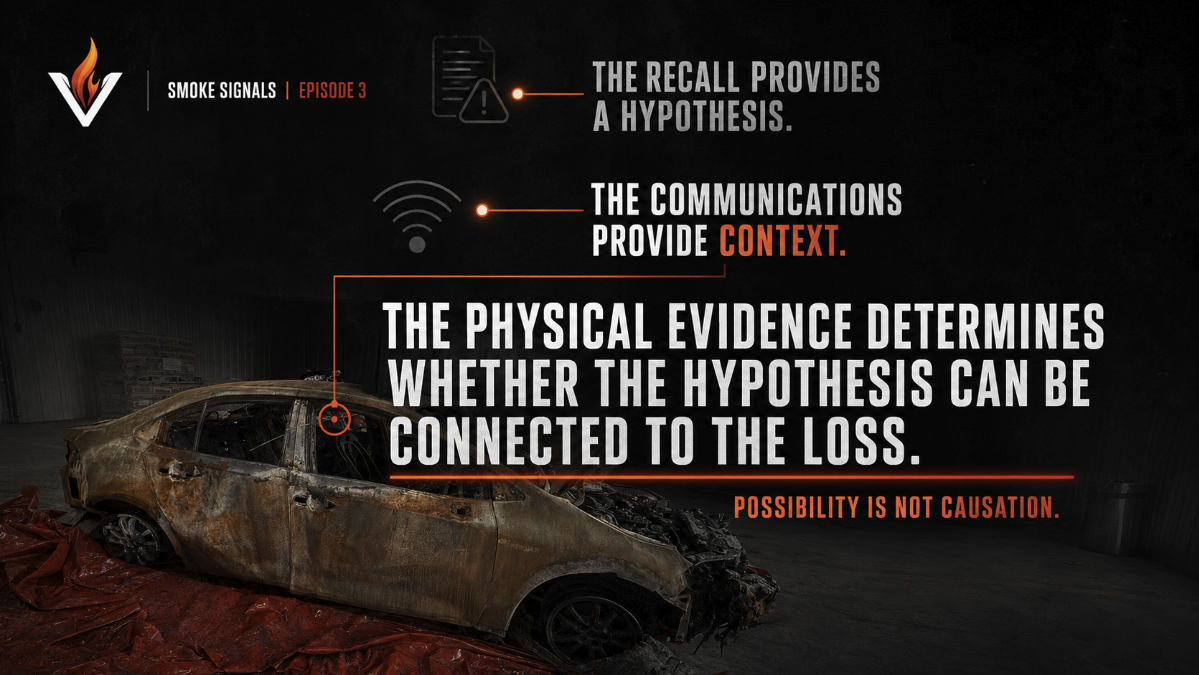
The recall provides a hypothesis.
The communications provide context.
The physical evidence determines whether the hypothesis can be connected to the loss.
THE DIGITAL FIRE SCENE MAY CONTINUE CHANGING
Traditionally, investigators photographed the vehicle, documented fire patterns, retained suspected components, preserved wiring, collected samples, and maintained the chain of custody.
Those fundamentals remain essential.
But the modern vehicle contains another category of evidence. It contains data.
Some information may be stored within the vehicle. Other information may be retained on the owner's phone or within systems controlled by the manufacturer, dealership, charging provider, roadside service, fleet manager, insurance program, or another connected platform.
Records may be overwritten during continued operation. They may disappear when power is lost, a module is replaced, an account is closed, a subscription ends, or a retention period expires. They may also be altered when the vehicle is energized, moved, repaired, scanned, reset, or updated.
An automatic or owner-authorized update could change the vehicle's operating logic after the fire. A remote command could wake electronic modules or change recorded conditions. A diagnostic scan could clear or overwrite information. Disconnecting or reconnecting power could affect volatile records. Salvage processing could separate the vehicle from the accounts and communication systems connected to it.
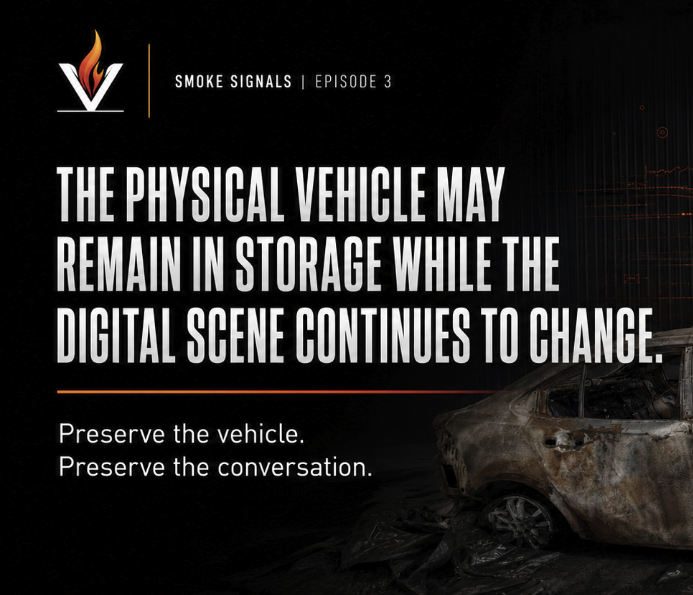
The physical vehicle may remain in storage while the digital scene continues to change.
That is the preservation problem.
The immediate objective should not be to prove that a recall, software defect, or electronic communication caused the fire. It should be to preserve the information necessary to evaluate whether those conditions played any role.
That may require prompt documentation and preservation of:
The vehicle identification number and exact equipment configuration
Software and firmware versions present at the time of the loss
Update histories and the last recorded system communications
Diagnostic, telematics, fault, and connected-vehicle data
Owner-application alerts, screenshots, messages, and notifications
Manufacturer, dealership, warranty, and roadside-assistance records
Recall status, charging history, and relevant remote commands
Photographs and video recorded before suppression or movement
Physical wiring, connectors, controllers, modules, and protection devices
Every material post-loss action involving the vehicle
The owner's phone may be a potential source of relevant evidence. That does not mean the entire device should automatically be collected. It means that relevant application records, alerts, messages, and screenshots should be identified and preserved appropriately.
Manufacturer-held information may also require prompt attention. A request made months after the loss may encounter expired retention periods, overwritten records, closed accounts, completed updates, or systems that no longer reflect the vehicle's prefire condition.
The scene did not remain unchanged simply because the vehicle remained parked.
LEVERAGING MODERN VEHICLES WITH MODERN FORENSICS
The initial examination of a modern vehicle fire cannot be treated as a simple documentation assignment.
Carriers need timely information for coverage, recovery, liability, and claim handling. Insureds need damaged vehicles removed. Manufacturers may request an examination. Repair facilities, towing companies, and salvage vendors may be preparing to disconnect, scan, move, dismantle, or dispose of the vehicle.
The investigator must work within those competing interests while protecting both the physical and digital evidence.
At Vector Forensic Fire Analysis, we do not begin with the recall and work backward toward the fire.
We begin with the fire.
We systematically examine the scene, identify the area of origin, evaluate the available ignition sources, document the physical evidence, and develop hypotheses from the data. In parallel, we determine whether the vehicle's technology can help test those hypotheses and what information must be preserved before it changes or disappears.
The initial forensic process should establish:
The available area of origin and competent ignition sources within it
The condition and location of potential first fuels
The viable ignition sequences and competing hypotheses
The digital information, owner applications, and connected services that may exist
The physical components and electronic records requiring preservation
The interested parties who may need to receive notice
Whether additional investigation is proportionate to the recovery or defense potential of the loss
A recall may identify a known failure mode. A warranty history may identify a developing pattern. A diagnostic record may establish that a fault occurred. An owner application may document a warning. A software history may establish how the system was configured to respond. Manufacturer records may help reconstruct what the vehicle transmitted and what was communicated back.
Those pieces must still be connected to the area of origin, the physical damage, the available first fuels, and a scientifically supportable ignition sequence.
That is the difference between identifying a possibility and establishing a cause.
Modern technology does not replace traditional fire investigation. It adds another evidentiary layer.
Depending on the loss, the process may include rapid origin-and-cause assessment, recall and vehicle-systems research, physical and digital evidence preservation, owner-application documentation, manufacturer-record preservation, three-dimensional scene documentation, evidence collection, laboratory examination, interested-party coordination, and subrogation or defense analysis.
Not every vehicle fire requires the same investigative scope.
Every vehicle fire requires the right questions to be asked before the evidence changes.
THE LARGER LESSON
The Lucid Air recall is not important merely because it involves an electric vehicle.
It demonstrates how the relationship between hardware, software, communications, and human interaction has changed the modern fire scene.
Burn patterns may help identify where the fire began.
Physical components may help explain how energy was transferred.
Software may help explain how the system was permitted to operate.
Electronic records may help establish what the vehicle detected.
Owner applications may help establish what was communicated.
Manufacturer records may help reconstruct the two-way conversation.
Preservation determines whether those questions can still be answered.
The modern vehicle is communicating.
The question is whether we are listening early enough and preserving what it said.
If we preserve only the burned vehicle, we may preserve only part of the fire scene.
The goal is not simply to preserve the answer someone expects to find.
The goal is to preserve the question, the conversation, the context, and the evidence necessary to reach a defensible conclusion.
Vector Forensic Fire Analysis
Professional. Responsive. Defensible.
Excellence… Every Assignment. Every Client. Every time!