
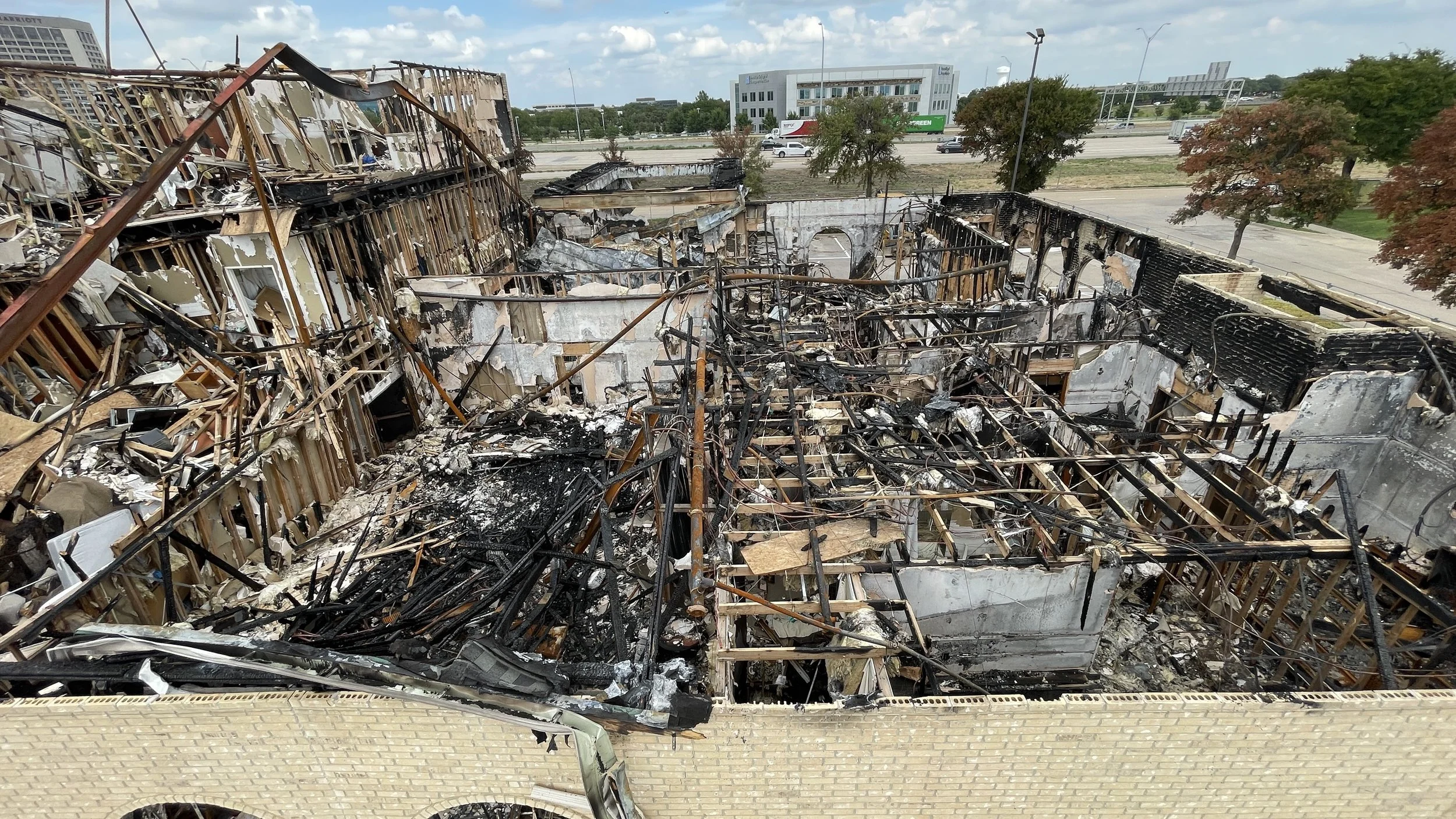
***EXAMPLE LOSS - Credit: W.D. Bradley Circa 2022
In a major fire loss, the success of an investigation often begins long before an investigator steps inside the building.
The recent fire at the DoubleTree Hotel in Laredo, Texas, serves as an important reminder of the complexities associated with large-loss fire investigations. With significant structural damage, safety concerns, high governmental staff occupancy (interview considerations), and restricted access to portions of the property, the incident highlights challenges that can arise when investigating a major commercial fire.
While the cause of this fire remains under investigation, the situation provides an opportunity to discuss an important question:
What does a successful large-loss fire investigation actually look like?
For insurance carriers, adjusters, attorneys, and property owners, success involves much more than determining where a fire started. It requires a coordinated approach that protects evidence, supports defensible conclusions, and allows important claim decisions to move forward.
1. Success Begins with Scene Safety
Large commercial fires, especially high-rise buildings, often leave behind compromised structural components, unstable debris, damaged building systems, and hazardous conditions.
Before investigators can begin examining and determining an area of origin, the structure may require evaluation by engineers and other qualified professionals.
These delays are sometimes unavoidable, but they do not mean the investigation must come to a complete stop.
Surveillance footage, witness statements, dispatch records, fire department observations, and building system information can be gathered while the physical scene remains inaccessible.
The goal is to make productive investigative decisions without compromising safety.
2. Early Evidence Preservation Protects Future Opportunities
One of the greatest risks following a major fire is the loss of evidence during emergency stabilization, cleanup, demolition, or restoration.
A component that initially appears insignificant could later become essential to understanding the ignition sequence.
For this reason, investigators and claim professionals should consider preservation needs as early as possible.
This includes identifying potential areas of interest, documenting conditions, maintaining appropriate chain of custody procedures, and coordinating with parties who may have a legitimate interest in examining the evidence.
For insurers, these steps may also preserve potential subrogation opportunities or help support the defense of a claim.
Evidence that is lost cannot always be recreated, and decisions made during the first few days can influence an investigation months or even years later.
3. Large Losses Require a Coordinated Team
A successful large-loss investigation rarely happens in isolation.
Depending on the circumstances, the investigation may involve fire investigators, structural engineers, electrical engineers, fire protection engineers, insurance adjusters, forensic specialists, legal counsel, restoration professionals, and public authorities.
Each participant brings a different responsibility to the process.
Clear communication helps establish investigative priorities, coordinate safe access, avoid unnecessary duplication, and ensure that evidence is properly documented before conditions change.
An organized approach can also help minimize unnecessary delays and expenses while maintaining the independence of the origin and cause investigation.
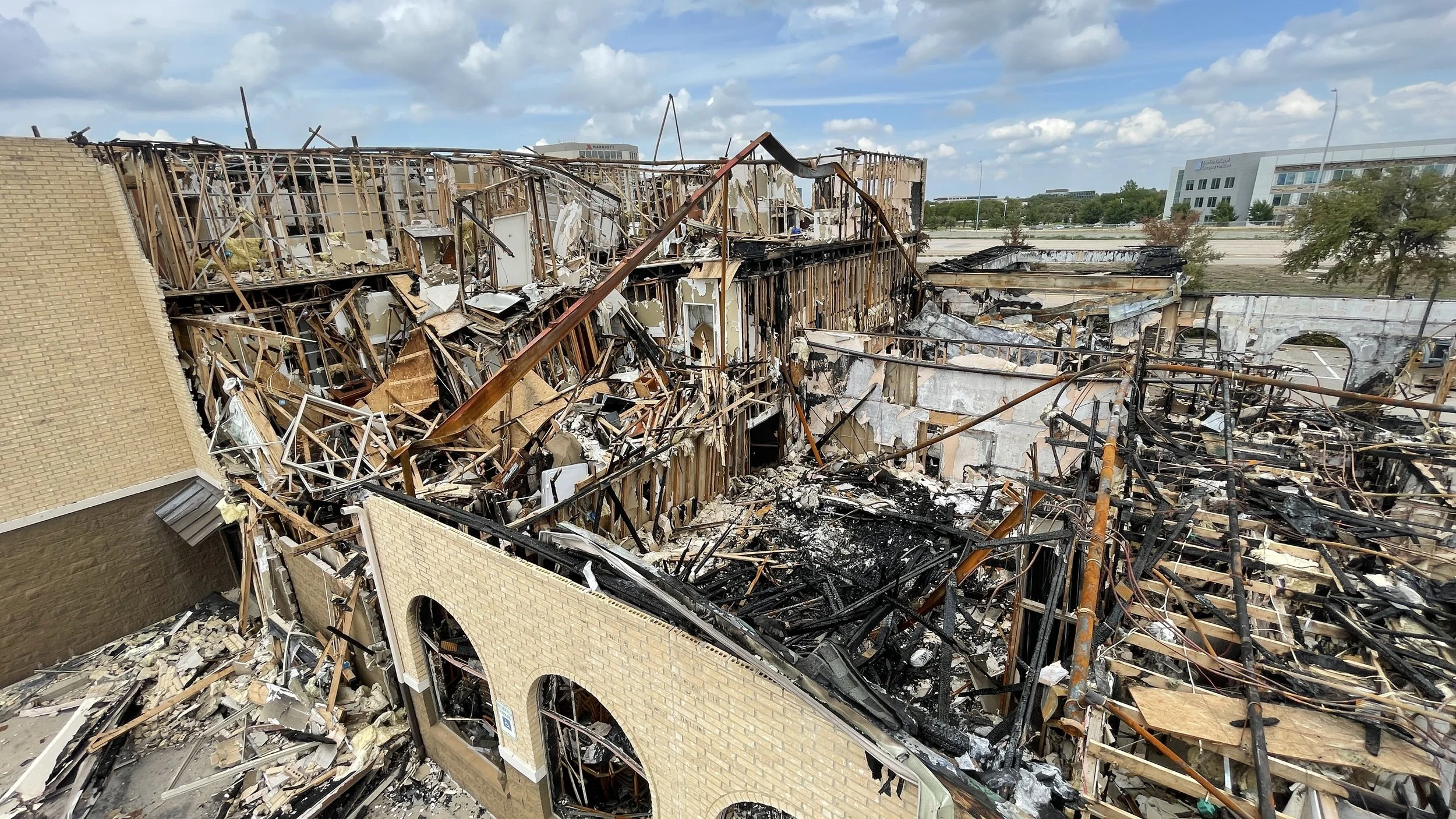
EXAMPLE LOSS — Credit: W.D. Bradley, circa 2022
4. Defensible Conclusions: Finding Answers That Drive Successful Outcomes
With high-dollar exposure, business interruption, extensive property damage, and potential liability, major commercial fires demand more than a basic origin and cause determination.
They require a comprehensive investigative strategy focused on identifying not only how a fire started, but also why it developed into a catastrophic loss.
A successful investigation brings together the right technical experts early, using a systematic, scientifically supported approach to uncover answers that might otherwise be overlooked.
NFPA 921, Guide for Fire and Explosion Investigations, provides the framework for evaluating evidence, developing and testing hypotheses, and reaching defensible conclusions. However, the value of a strong investigative team extends beyond identifying the initial ignition source.
In large-loss investigations, some of the most significant findings and recovery opportunities may lie in understanding how and why the fire spread, rather than simply where it began.
When evaluating a loss involving substantial fire growth, such as the recent hotel fire in Laredo, investigators should consider several critical questions:
Fire Detection: Did the detection systems operate as designed, and was the fire identified early enough to support an effective response?
Alarm Signaling and Notification: Were signals properly transmitted, received, and communicated to occupants and emergency responders?
Fire Suppression Systems: Were sprinkler systems and other fire protection features properly designed, maintained, and operational when needed?
Fire and Smoke Spread: Did compartmentation, fire rated assemblies, doors, penetrations, and smoke control systems perform as intended?
System Maintenance and Compliance: Could inspection histories, maintenance deficiencies, system impairments, or changes to the building have contributed to the extent of the damage?
These are investigative considerations, not conclusions about the Laredo incident.
For insurance carriers and subrogation professionals, these questions can reveal additional liability considerations, overlooked responsible parties, and recovery opportunities associated with the magnitude of the loss, even when the initial ignition event is only one part of the overall claim.
This is where the early involvement of a multidisciplinary forensic team can make a substantial difference. Origin and cause investigators, fire protection engineers, electrical engineers, and other specialized experts can work together to examine not only ignition but also the systems and conditions that influenced fire development and damage.
The goal is not simply to determine what started the fire. It is to develop the most complete, defensible explanation of why the loss occurred, why it became so significant, and whether additional opportunities for recovery exist.
At Vector Forensic Fire Analysis, we believe successful large loss investigations are driven by the right expertise, the right questions, and the determination to pursue meaningful answers beyond the obvious.
Because identifying where a fire started is important. Understanding why it became a multimillion-dollar loss can be just as valuable.
5. Success Means Providing Clarity for the Claims Process
For an insurance carrier or adjuster managing a major loss, technical findings are only part of the equation.
They also need to understand what has been established, what remains uncertain, what evidence requires protection, and what investigative steps should happen next.
Timely communication and well supported reporting can help claim professionals make informed decisions regarding additional experts, evidence examinations, potential recovery, litigation strategy, and claim progression.
The ultimate goal is not simply to complete an investigation. It is to provide reliable information that can withstand technical scrutiny and assist the people responsible for resolving the loss.
The Takeaway
Large loss success is not measured solely by how quickly an investigator reaches a conclusion. It is measured by the quality of the decisions made throughout the investigation.
From initial scene preservation to final reporting, every phase matters.
The recent Laredo hotel fire is a timely reminder that complex fire losses require patience, collaboration, technical expertise, and a commitment to the scientific method.
At Vector Forensic Fire Analysis, we believe that successful fire investigations begin with a disciplined process, careful attention to evidence, and a commitment to providing objective, defensible findings.
Because in a large loss, what happens before the origin and cause determination can be just as important as the determination itself.
Smoke Signals | Vector Forensic Fire Analysis
Sources
Laredo Morning Times — DoubleTree Hotel Fire and Structural Safety Concerns, October 8, 2026
National Fire Protection Association — NFPA 921: Guide for Fire and Explosion Investigations
#SmokeSignals #VectorForensicFireAnalysis #FireInvestigation #LargeLoss #OriginAndCause #InsuranceClaims #Subrogation #ForensicInvestigation #PropertyClaims
EMAIL ME! | SUBMIT NEW ASSIGNMENT
W.D. “Wes” Bradley, IAAI-CFI, MSci, BSci (Hons.)
+1 (936) 323-2152 | client.services@vectorffa.com | www.VectorFFA.com
EXCELLENCE… Every Assignment. Every Client. Every Time!